
'The robust tax collections give the finance minister a fair amount of headroom for an expansionary fiscal policy.'
India and China have mostly set aside their bilateral differences in order to champion the cause of developing countries at the World Trade Organisation (WTO). That seems to be changing. During the latest round of China's trade policy review, India questioned its northern neighbour's claim that it was a developing country, since, going by the World Bank's definition, its per capita income belongs to that of an upper middle income country. "As per the per capita income level, the Chinese economy belongs to 'upper-middle income'. "How can China still claim to be a developing country? "What are the indicators which China is using to claim such a status?" India asked.
'We have already given Rs 1.59 trillion to states.' 'So, there is no question of giving them more.'

The central government is likely to exceed the budgeted tax collection target of Rs 22.2 trillion for the current fiscal year, led by better indirect tax mop-up, compliance measures, and recovery in most sectors following the second wave of the Covid pandemic. Personal income and corporate tax collections (net of refunds) grew 74 per cent to Rs 5.70 trillion in the first half of the current financial year, driven mainly by advance tax and TDS payments. The target for the current fiscal year is Rs 11.08 trillion; higher taxes are paid usually towards the end of a fiscal year.

While Panama and Paradise Papers had majorly focused on foreign entities created by entities, corporates or individuals overseas, Pandora is about the new method adopted by wealthy elites by setting up multiple layered complex trust structures.
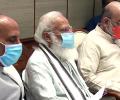
Amit Shah's net worth grew 32 per cent to Rs 37.91 crore, mainly due to 80 per cent appreciation in the market value of his securities.
The finance ministry will kick-start the exercise to prepare the Union Budget for financial year 2022-23 (FY23) from October 12, according to an official notification released on Monday. "The pre-Budget meetings as well as the meetings to discuss the revised estimates will start from October 12 and will continue till the second week of November," according to the Budget circular of the Department of Economic Affairs' Budget Division. The Union Budget is expected to be announced on February 1, as has been the practice of the past few years.
The Central Board of Direct Taxes (CBDT) has extended various tax returns filing deadlines till December 31 this year but it will continue to levy interest on delayed payments made after July 31, the original due date. Officials say tax payment has to be done through net banking, and the assessee doesn't need to use the e-filing portal, which has been facing glitches. So, taxpayers have to bear the interest payment liability of 1 per cent per month on the outstanding tax for those who filed a return after July 31.

'When you plot the growth, -- 7.5 per cent for Q2, 0.4 per cent for Q3, 1.6 per cent for Q4 and 20.1 per cent for Q1 now -- all you see is a 'V'.' 'You don't see any other alphabet in the shape there.'

The income-tax (I-T) department is working on integrating the new e-filing portal with stock exchanges to help tax authorities track trade transactions, including futures and options. The integrated system will look at discrepancies between the data disclosed by an assessee and match it with data fetched from stock exchanges, using artificial intelligence, said two officials in the know. This will help detect and red-flag such matters, particularly those related to non-filers of income-tax return (ITR).
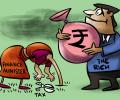
Ahead of the second instalment of advance tax, the revenue department is scrutinising entities that have registered negative growth in their tax deducted at source (TDS) payments, even when they reported healthy advance tax payments. According to sources, taxmen have observed a mismatch in TDS payments from at least 60-65 small to mid-sized companies. Officials said it is unusual for TDS to not increase, given the improved turnover and profits - if higher advance tax payments are any indication.

The finance ministry has initiated an internal survey of the faceless regime to examine its effectiveness.

The government is exploring legal options, including bringing an Ordinance, to tackle the problem of income-tax litigation on reassessment notices under old, time-barred norms, according to official sources. This has come in the wake of writ petitions filed by companies and individuals in recent weeks to challenge the validity of the notices issued by the tax department between April 1 and June 30 and under the old norms.

Now that almost 10 infrastructure ministries have submitted a fresh list of their core infrastructure assets, the government has realised it stands to make much more money from asset monetisation than previously thought. Two persons in the government said it stood to garner over 30 per cent more than the earlier estimates of Rs 2.5 trillion over the next four years under the National Monetisation Pipeline (NMP). The NMP, which is being prepared by Niti Aayog, is in the advanced stages of finalisation and is expected to be unveiled in August.
The much-anticipated cryptocurrency bill, however, is missing from the list, reports Shrimi Choudhary.

Maintaining a rapid pace of the vaccination drive and quickly bridging healthcare infrastructure gaps across both urban and rural areas would emerge as the most sustainable stimulus for durable recovery of the Indian economy, says a report by the department of economic affairs.

The probe agency is learnt to have taken possession of multiple physical and digital records during a search operation conducted on the premises of the South Korean firm in Delhi and Mumbai this week.
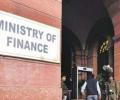
The finance ministry on Wednesday reimposed expenditure curbs on ministries and government departments for July-September quarter. There will be no spending restrictions on the ministries of health, rural development, agriculture, MSME (micro, small and medium enterprises) and railways as part of a two-pronged strategy. "The existing guidelines for expenditure control have been reviewed. "Keeping in view the evolving situation arising out of Covid-19 and anticipated cash position of the government, it is felt essential to regulate Quarterly Expenditure Plan (QEP)/Monthly Expenditure Plan (MEP) of specific ministries/departments for July-September, 2021," the Department of Economic Affairs in the finance ministry said in a notification.

Direct economic stimulus measures such as tax cuts for individuals and industry would have helped to prop up the Indian economy which was hit hard by the lockdowns across several states in India, say economists and corporate leaders. While the measures announced on Monday are focussed more on the supply side, these steps would take a lot of time to move the needle for the economy.

The Goods and Services Tax (GST) Council, chaired by Union Finance Minister Nirmala Sitharaman, will likely consider on Saturday a GST rate cut for Covid-19 relief essentials and drugs for treating the black fungus disease and might leave the vaccines untouched. The meeting is being held following a report submitted by a Group of Ministers (GoM) to the GST Council on Monday. The GoM, set up by the Council on May 28, was mandated to look at tax exemption and concessions on various Covid items including vaccines, drugs, and equipment.
 © 2025 Rediff.com - Investor Information - Advertise with us - Disclaimer - Privacy Policy - Sitemap - Feedback - About us - Terms of use - Grievances